

Digital products must have a solid foundation to get users’ attention. For this reason, a designer needs to make a well-organized information architecture. It is used to organize information, data, or content in a practical and long-lasting manner. Professional developers carry out this work to deliver fruitful results at the end of any project.
In information architecture, users focus on the organization of information associated with a digital product or a service. To help you understand what information architecture is and its importance, we are sharing a complete guide about it along with its principles, types, and execution. Read the article till the end to get the complete concept of information architecture.
User experience, or UX, refers to how customers feel while interacting with a product or service design. Information architecture is a crucial component of user experience design because it structures apps for mobile phones as well as websites and aids users in processing the information they need. This way, users can get authentic information without wasting time searching for more details.
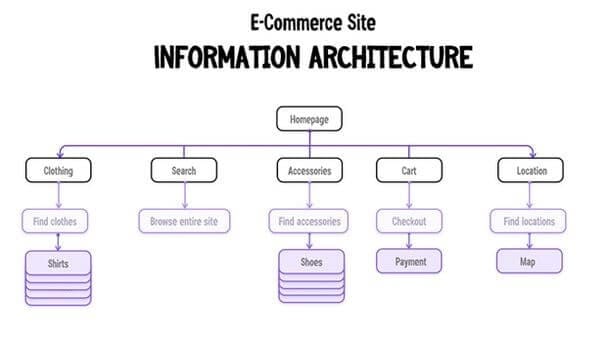
In UX information architecture, information is organized systematically, making it easier for a user to understand without effort. It helps design website navigation, sitemap, user flows, and other elements if the designer understands how a user behaves and seeks information. To fully understand what is information architecture in UX when designing websites, there are the following considerations to keep in mind:
Cognitive psychology has an impact on both the interactions you create and the way you structure information. It studies how the mind functions and what mental processes occur there. The role of an architect is to analyze how these two will function together. Users’ presumptions before interacting with a website or application are known as mental models.
Accessible information at a point depicting originality from a user’s mind results in easy work. The quantity of information a user can process at any given time is known as cognitive load. Information architects can avoid accidentally overwhelming a user with too much information at once by considering the user’s cognitive load.
Although making decisions may not seem like psychology, it is. Making a decision or choosing an alternative is a cognitive process we all engage in. By delivering specific information at crucial times, information architects can assist anyone in making judgments.
Information architecture has a deep link with user interface and design. Although they are closely related, information architecture and user experience somehow differ. You can only have a positive user experience with well-designed information architecture. If the fundamental organization is bad, users won’t be delighted by even the most beautiful websites created by UX information architects.
IA and UX design includes everything connected to a user’s perception of interaction with the service or product and emotions about the final output. A single phase in the UX information architecture process is the creation of IA using the best UX information architecture tools. User research, testing, content inventory, wireframing, and prototyping are other processes that must be carried out with the help of an information architect.
There are three primary types of brand architecture: Monolithic, Endorsed, and Pluralistic. By understanding these approaches, you can decide which strategy best aligns with their goals and offerings.
At the heart of the monolithic brand architecture lies the concept of a “Branded House.” In this approach, a strong and unified corporate brand takes center stage, encompassing all products, services, and sub-brands under its umbrella. The brand’s equity is built around a single identity, enabling a seamless extension of its reputation and values to all offerings.
In an endorsed brand architecture strategy, the corporate brand serves as an endorser for each sub-brand or product line. This approach strikes a balance between having distinct identities for individual offerings while benefiting from the credibility and recognition of the parent brand.
The pluralistic brand architecture, often called the “House of Brands,” involves multiple distinct brands or sub-brands that operate independently from the corporate brand. Each brand within the portfolio maintains its own identity and messaging, catering to specific target audiences and industries.
Selecting the appropriate brand architecture strategy hinges on a company’s goals, offerings, and target audience. A well-thought-out brand architecture aligns with the company’s vision, leverages existing equity, and ensures consistency across all touchpoints.
Brand architecture isn’t a one-size-fits-all concept; it’s a strategic decision that shapes how a company presents itself to the world. Whether opting for the unified approach of a monolithic structure, the balanced endorsement of an endorsed architecture, or the diverse independence of a pluralistic strategy, you must consider their unique circumstances and aspirations.
By embracing the most suitable brand architecture type, your business can create a framework that resonates with your audience and drives growth and differentiation in a competitive market.
Developing a robust brand architecture strategy is akin to constructing a well-designed building; it requires careful planning, a strong foundation, and a clear blueprint. Here I will outline the key steps to develop an effective brand architecture strategy that aligns with your business objectives and resonates with your target audience.
Define Business Goals and Offerings
Begin by comprehensively understanding your company’s overarching goals and objectives. What are you aiming to achieve in the short and long term? Analyze your existing offerings, sub-brands, and product lines. This insight will serve as the foundation for structuring your brand architecture strategy.
Segmentation and Target Audience
Segment your offerings based on customer preferences, needs, and market dynamics. Identify your target audience for each offering or sub-brand. Understanding your audience’s motivations and expectations is critical in tailoring your brand architecture to communicate value effectively.
Determine Hierarchy and Relationships
Decide how closely connected you want your corporate brand to be with your sub-brands or products. Evaluate the level of synergy and alignment between different offerings. You can opt for a monolithic, endorsed, or pluralistic approach, depending on your strategy.
Naming Conventions and Visual Identity
Establish a consistent naming convention that reflects the relationships between your brands, sub-brands, and products. Determine how closely the names should be aligned or differentiated. The visual identity, including logos, color schemes, and design elements, should reinforce the chosen brand architecture approach.
Communication Strategy
Craft a clear and concise communication strategy explaining your brand architecture’s rationale. This strategy should be used internally to educate employees and externally to inform customers. Transparency about brand relationships and value propositions will build trust and reduce confusion.
Implementation and Rollout
Execute the brand architecture strategy systematically. Update marketing materials, websites, and other touchpoints to reflect the new structure. Ensure consistency in messaging and visuals across all communication channels.
Monitor and Adapt
Brand architecture isn’t static; it must evolve with changing market dynamics and business goals. Continuously monitor customer feedback, market trends, and business performance. Be prepared to adapt your brand architecture strategy to stay relevant and effective.
Seek Professional Guidance
Developing a brand architecture strategy can be complex, especially for larger organizations with diverse offerings. Consider seeking guidance from branding experts, consultants, or agencies specializing in developing brand architecture strategies. Their experience can provide valuable insights and ensure your strategy aligns with best practices.
Developing brand architecture is a complex endeavor that involves aligning multiple brand elements, offerings, and strategies to create a cohesive and effective structure. Here are some common challenges that you might face while developing brand architecture:
Overcoming these challenges requires strategic planning, effective communication, stakeholder engagement, and continuous monitoring.
The future of brand architecture holds exciting prospects as it adapts to the changing landscape of business, technology, and consumer behavior. Several trends and developments are expected to shape the evolution of brand architecture in the coming years:
The brand architecture will move towards hyper-personalization, creating micro-brands or sub-brands tailored to specific customer segments or niches. This approach allows brands to connect more deeply with diverse audiences and cater to their unique preferences.
The future brand architecture will be more fluid and adaptive, capable of quickly accommodating new product lines, market shifts, and emerging technologies. Brands will embrace modular architecture that allows for easy integration and evolution.
As the lines between online and offline experiences blur, brand architecture must seamlessly integrate digital and physical touchpoints. Brands will create consistent experiences across various channels, ensuring customers can engage fluidly.
Brands will become part of larger interconnected ecosystems. The brand architecture will extend beyond individual products or services to consider how a brand fits into a broader ecosystem, offering collaborative and holistic solutions.
The future of brand architecture will leverage data analytics and AI-driven insights to refine strategies. Brands will better understand customer behaviors and preferences, allowing for more personalized and effective architecture.
The brand architecture will embrace virtual and augmented reality to create immersive experiences. Customers will interact with brands innovatively, and architecture will adapt to facilitate these interactions.
Global brands will focus on adapting their architecture to resonate with diverse cultural contexts. Successful brands will maintain a global identity while tailoring their architecture to local nuances.
Automation and AI will play a significant role in brand architecture, enabling personalized interactions, chatbots, and dynamic content delivery. The architecture will need to integrate these technologies seamlessly.
Here I have listed a few examples of brand architecture strategies used by well-known companies:
Apple (Monolithic Brand Architecture)
Apple employs a monolithic brand architecture approach, where the corporate brand is the focal point, and all products are aligned closely under it. Whether it’s the iPhone, iPad, Mac, or any other Apple product, the brand maintains a consistent visual identity and message, leveraging the strong equity of the Apple name.
Procter & Gamble (Pluralistic Brand Architecture)
P&G employs a pluralistic brand architecture, often called a “House of Brands.” P&G manages a diverse portfolio of brands in various industries, each operating independently with its own brand identity. Brands like Gillette, Olay, and Tide have distinct brand personalities under the P&G umbrella.
Marriott International (Endorsed Brand Architecture)
Marriott employs an endorsed brand architecture with its various hotel brands. Marriott is the parent brand that endorses sub-brands like Courtyard by Marriott, JW Marriott, and The Ritz-Carlton. Each sub-brand retains its individuality while enjoying the support of the Marriott name.
Unilever (Endorsed and Pluralistic Brand Architecture)
Unilever combines elements of endorsed and pluralistic brand architecture. While Unilever is a strong corporate brand that endorses many of its sub-brands, it also allows certain brands to operate independently. For example, Ben & Jerry’s maintains its distinct identity within the Unilever portfolio.
These examples showcase how companies choose brand architecture strategies based on their goals, offerings, and target audiences.
Developing an effective brand architecture strategy demands meticulous planning, a deep understanding of your offerings and audience, and a clear vision of your brand’s identity. By carefully crafting your brand architecture strategy, you lay the groundwork for a brand ecosystem that is easily navigable and capable of driving customer engagement, loyalty, and growth. As your business evolves, your brand architecture strategy will remain a steadfast guide, ensuring that your brand story is conveyed precisely and positively.