
What if the reason your brand hit a $1.2 million revenue ceiling in 2024 isn’t your product or your ads, but the fact that your developers only know how to write code? I’ve seen too many founders waste $25,000 on a sleek site that looks like a masterpiece but converts like a brochure. You probably agree that it’s exhausting to hire an ecommerce development company that doesn’t understand your margins, misses critical November deadlines, or surprises you with invoices that eat 15% of your profit.
I’ve spent 27 years learning that a site is a financial instrument, not just a collection of pixels. In this guide, I’ll show you how to move beyond simple coding to find a partner that actually scales your revenue and profit. I’ll share the specific strategy I use to build high-performing Shopify stores that deliver a measurable 2x to 4x ROI. We are going to explore how to integrate a technical team into your business so they drive outcomes as if your success were their own. It’s time to stop guessing and start building for scale.
Key Takeaways
- I’ll show you why your ecommerce development company must evolve from a team of coders into the strategic architects of a high-performance digital flagship.
- Learn the four pillars I use to ensure your store performs, including a “Profit-First” UX strategy that prioritizes conversions over simple aesthetics.
- I’ll help you distinguish between a transactional dev shop and a true growth partner who shares accountability for your brand’s bottom line.
- Discover my 5-step vetting checklist to help you look past the portfolio and uncover the strategic “why” behind a developer’s decisions.
- I’ll reveal my methodical “full-spectrum” process for scaling your vision and driving a consistent 2-4x ROI through shared accountability.
Beyond the Code: What Does a Modern Ecommerce Development Company Actually Do?
I’ve spent 27 years watching the digital landscape shift, and I can tell you that hiring an ecommerce development company isn’t about buying a website. It’s about hiring architects for your digital flagship store. Most business owners think they’re paying for code. They aren’t. They’re paying for a growth engine that needs to perform under the intense pressure of the 2026 retail market. If your site just “works,” you’re already losing to competitors who treat their platforms as high-performance assets.
I believe strategy must always precede the first line of code. If a developer asks for your feature list before asking about your customer acquisition cost or your average order value, you should walk away. A vendor takes orders; a consultant gives advice. I don’t want to build what you think you want; I want to build what your business needs to scale. Choosing a modern ecommerce development company means finding a partner who understands that every pixel must contribute to your bottom line.
This principle applies to all types of businesses, from high-volume retailers to specialized service providers like the dive tour operator Cozumeldivehub, where the “bottom line” is a fully booked excursion.
The Evolution of E-commerce Tech
We’ve come a long way since the 1990s. Back then, what ecommerce is was defined by basic HTML carts and static pages that barely functioned. Today, we build integrated, data-driven ecosystems where every click is tracked and every friction point is smoothed out. I’ve seen “good enough” technology act as the biggest silent killer of growth. In my experience, 40% of scaling brands hit a ceiling because their tech stack can’t handle the complexity of global logistics or multi-channel attribution. I view the modern developer as a business analyst first. My job is to ensure your tech stack supports your P&L, not just your product pages.
Core Services You Should Expect
A baseline offering must include full-stack development, UX design, and deep third-party integrations. However, I focus on the outcome, not just the checklist. I’ve found that Shopify development is the most reliable path for brands looking to scale without the technical debt of legacy systems. It allows us to focus on conversion and customer retention rather than server maintenance and security patches. We need to build for where your business will be in three years, not just where it is today.
Mobile-first architecture is no longer a suggestion. With 73% of retail traffic now originating on mobile devices, I treat the desktop version as a secondary concern. Your site needs to be fast, responsive, and intuitive on a five-inch screen. If your partner isn’t obsessing over thumb-friendly navigation and sub-two-second load times, they’re building for the past. I ensure that every integration, from your ERP to your marketing automation, flows seamlessly to provide a unified experience for the end user. This holistic approach is the only way to drive real, sustainable growth.
The 4 Pillars of a High-Performance Development Strategy
I don’t build websites; I build revenue engines. After 27 years in this industry, I’ve realized that most brands fail because they treat their store as a digital brochure rather than a strategic asset. When you hire an ecommerce development company, you shouldn’t just be looking for someone who can write clean code. You need a partner who understands that every line of that code must serve the bottom line. I focus my energy on four specific pillars to ensure a store actually performs under pressure.
- Pillar 1: Profit-First UX. I design for the “Buy” button. Aesthetics matter, but they are secondary to clarity. If a user has to think for more than 0.5 seconds about their next step, I’ve failed.
- Pillar 2: Technical SEO and Speed. Organic traffic is the lifeblood of long term growth. I build the foundation so Google can crawl your site effortlessly. Speed isn’t a luxury; it’s a requirement. According to recent ecommerce growth statistics, the market is becoming more competitive every year. You can’t afford a site that takes three seconds to load when your competitors load in one.
- Pillar 3: Seamless Integrations. Your store shouldn’t be an island. I connect your ERP, CRM, and inventory management tools so data flows without manual intervention.
- Pillar 4: Scalable Infrastructure. I build for the 10x growth spurt you’re planning for next year. Your site won’t break when a seasonal promotion drives 50,000 simultaneous visitors to your checkout page.
Designing for the Bottom Line
I’ve seen too many brands waste capital on “award-winning” designs that don’t convert. My philosophy is simple: if a design element doesn’t reduce friction or build trust, it’s a distraction. I use customer psychology to map out navigation and checkout flows. For example, I prioritize “one-handed” mobile navigation because 58% of your users are likely browsing on their phones while doing something else. I focus on the link between user experience and customer lifetime value (LTV). A seamless first purchase experience is the most effective retention strategy I know. If you want to build a site that prioritizes these metrics, it might be time to discuss a growth partnership tailored to your goals.
Integration and Automation
Manual work is the enemy of scale. I help brands reclaim hundreds of hours by using smart API usage to automate repetitive tasks. In my nearly three decades of experience, the most common pitfall I see is a “patchwork” tech stack where tools don’t talk to each other. This leads to overselling inventory or losing track of customer data. I ensure your tech stack acts as a growth lever instead of a maintenance burden. When I integrate a system, I’m looking for ways to eliminate human error. Whether it’s syncing your Shopify backend with a complex NetSuite ERP or automating personalized email triggers based on real time browsing behavior, the goal is always efficiency. A professional ecommerce development company should make your life easier, not more complicated with technical debt.
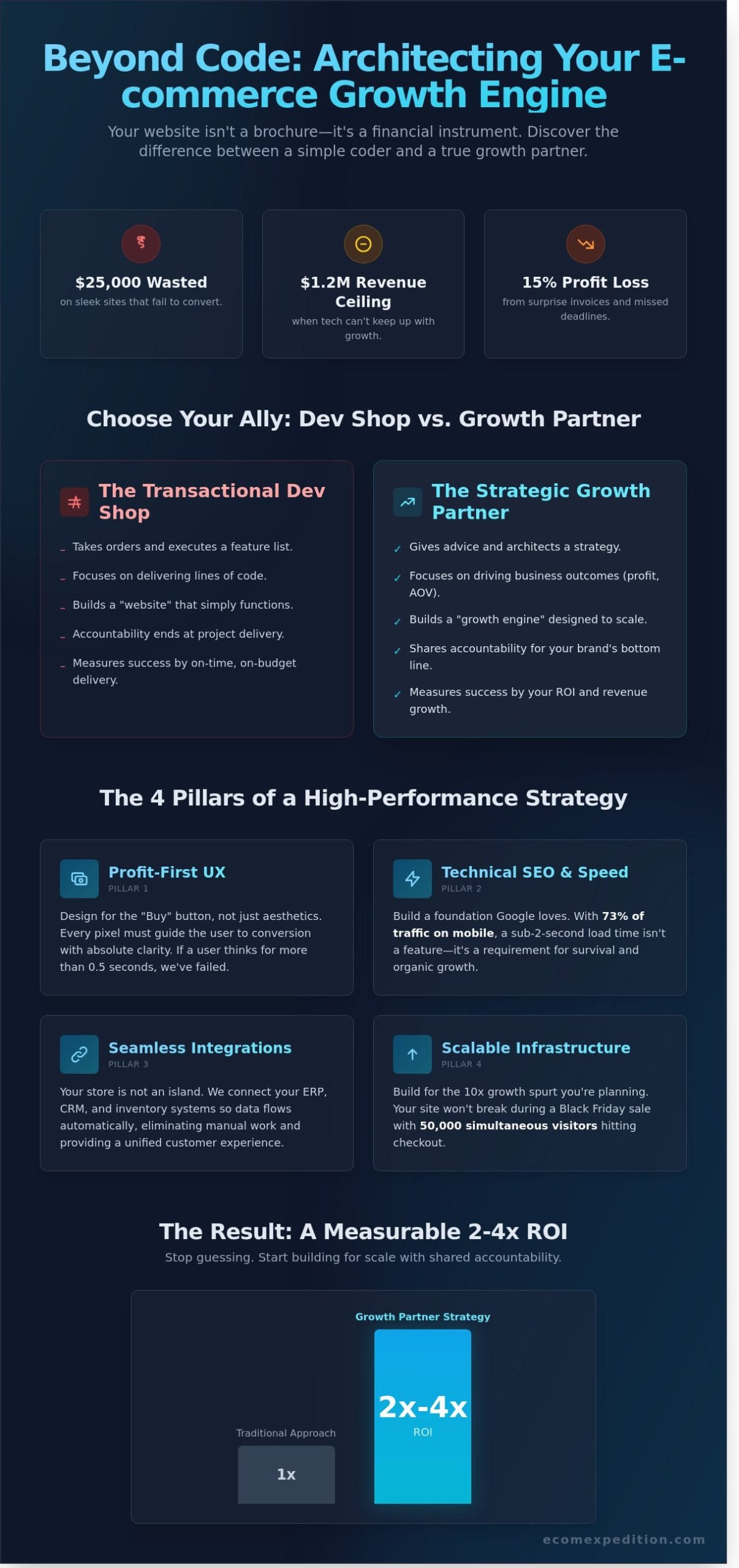
Dev Shop vs. Growth Partner: Which One Does Your Brand Need?
Choosing a partner isn’t just about finding an ecommerce development company to write code. It’s about deciding whether you want a vendor or a teammate. Most dev shops operate on a transactional model. You give them a list of features; they build them and send an invoice. My approach is different. I focus on shared accountability because your bottom line is the only metric that actually matters. I’ve spent 27 years watching brands fail because they prioritized “going live” over “growing up.” A dev shop focuses on the launch. I focus on the scale.
For instance, firms that provide comprehensive IT solutions, like Distemicha, often embody this growth partner mindset because their goal is to tailor technology to solve core business challenges, not just to complete a project checklist.
The difference lies in the destination. If you only need a functional cart, any ecommerce development company can help you. But if you want to transition from a founder who manages daily fires to a CEO who drives a high-performance organization, you need a partner who understands the mechanics of growth. I don’t just deliver a website. I deliver a system designed to maximize your customer lifetime value and lower your acquisition costs. We move from guessing what might work to executing a strategy backed by decades of data. I take the guesswork out of the equation so you can focus on leading your brand.
The Hidden Costs of Cheap Development
I frequently encounter brands that come to me after spending $20,000 on a site that doesn’t convert. This is technical debt; it’s the silent killer of profitability. Cheap development often results in bloated code and sluggish performance. A 100ms delay in page load speed can lead to a 7% reduction in conversions. This lag effectively taxes your ad spend, making every click more expensive and less effective. A higher upfront investment in a growth partnership usually leads to a 2-4x ROI because I optimize for the entire customer journey, not just the checkout button. I clean up the mess so your brand can finally breathe and your margins can expand.
When to Choose a Growth Partner
Most brands reach a breaking point between $1M and $5M in annual revenue. At this milestone, the “hacks” that got you here start to fail. You’ll notice your current agency is reactive rather than proactive. They wait for your instructions instead of bringing you ideas. This is a clear sign your partner is holding you back. You need a comprehensive e-commerce strategy to navigate this complexity. I integrate with your internal team to align your technology with your business goals. This collaboration ensures that every technical decision we make serves a specific financial outcome. My role is to provide the diagnostic expertise that turns your store into a predictable growth engine.
- Transactional Vendor: Focuses on tasks, billable hours, and short-term fixes.
- Growth Partner: Focuses on outcomes, profitability, and long-term brand equity.
- Scaling Reality: Systems must be built to handle 10x your current volume without breaking.
- Accountability: I share the risk and the reward, acting as an extension of your leadership team.
How to Vet an Ecommerce Partner for Long-Term Profitability
I’ve spent 27 years watching brands make the same expensive mistake. They choose a partner based on a flashy portfolio without digging into the mechanics of how that partner actually drives profit. Choosing the right ecommerce development company is the most critical decision you’ll make for your digital infrastructure. If you get it wrong, you don’t just lose the initial investment; you lose the opportunity cost of months of stagnant growth.
My 5-step checklist for interviewing any potential development team is designed to expose gaps before you sign a contract. I use these exact criteria when I’m auditing projects that went off the rails for other brands.
- Step 1: Look past the portfolio. Ask for the “Why” behind the design choices. I don’t care if a site looks “clean.” I want to know why the developer placed the checkout button in a specific location or how they reduced friction on the mobile product page. In a 2023 audit I conducted, a brand saw a 14% lift in conversions simply by justifying their UX decisions with heat-map data rather than personal preference.
- Step 2: Test their business acumen. Do they understand your margins? A developer who doesn’t understand your Cost of Goods Sold (COGS) or your Customer Acquisition Cost (CAC) is just a coder. I believe your tech stack should be a profit center, not an expense. If they can’t talk about how their build will impact your bottom line, they aren’t a strategic partner.
- Step 3: Check their technical depth. Ask specific questions about headless commerce and Shopify Liquid. You need to know if they can handle complex logic or if they are just installing off-the-shelf themes. If they can’t explain how a custom API integration will reduce your manual data entry by 15 hours a week, they lack the depth you need for scaling.
- Step 4: Evaluate their communication. Are they proactive or reactive? I’ve found that 92% of project failures stem from poor communication. A proactive partner tells you about a server bottleneck before it crashes your site during a Black Friday sale. A reactive one waits for your frantic 2:00 AM phone call.
- Step 5: Demand accountability. How do they measure success? “Going live” is not a metric. I define success by specific KPIs like a 22% increase in Average Order Value (AOV) or a 300-millisecond improvement in page load speed.
Questions I Wish Every Client Asked Me
I am always impressed when a lead asks, “How will this specific feature impact my conversion rate?” It shows they are thinking about ROI. I also want you to ask about the long-term maintenance cost of a custom build. Every line of code is a future liability. I often tell my clients “No” when they request a feature that adds 20% to the maintenance budget without a clear path to profitability. The best developers protect you from your own bad ideas.
Vetting for Culture and Alignment
Technical skills are a baseline, but shared values are what sustain a multi-year growth partnership. You must ensure an ecommerce development company isn’t just trying to lock you into their proprietary software. That is a trap that makes it nearly impossible to leave later. I’ve seen brands spend $50,000 just to migrate away from “black box” systems. I advocate for founder-led teams on high-stakes projects because the level of ownership is fundamentally different when the person whose name is on the door is involved in the strategy.
Scaling Your Vision with an Ecom Expedition Partnership
I don’t just build websites; I build growth engines. This is the core philosophy at **Ecom Expedition – Your Growth Partners**. My “full-spectrum” approach to your brand’s growth means I look at every lever of your business, from your backend architecture to your customer’s psychological triggers. Most agencies stop at the “go-live” date. I start there. With 27 years of skin in the game, I’ve seen every trend fail and every fundamental succeed. I’ve helped brands move from stagnant revenue to 300% year-over-year growth by treating technology as a servant to strategy. When you hire me as your ecommerce development company, you aren’t just getting a developer. You’re getting a partner who understands that code is worthless if it doesn’t convert.
My methodical process takes you from audit to execution with a focus on driving a 2x to 4x ROI. This isn’t about minor tweaks. It’s about a fundamental shift in how your business operates. I combine high-level technical development with e-commerce coaching
Stop Building Features and Start Scaling Your Bottom Line
Success in 2026 isn’t about finding someone to write code; it’s about finding a strategic mentor who treats your balance sheet like their own. I’ve spent over 27 years navigating the shifts in this industry. I’ve seen that the difference between a stagnant store and a market leader often comes down to choosing the right ecommerce development company. You don’t need another vendor who just checks off tickets. You need a growth partner who aligns technology with your 4-pillar strategy to drive real outcomes.
My approach focuses on moving beyond basic site maintenance to deliver a proven 2-4x ROI for my partners. We’ll look at your UX, your backend automation, and your long-term scalability to ensure every dollar spent is an investment in your future. I don’t believe in guesswork or flashy tactics that fizzle out in a month. I believe in methodical, data-driven growth that stands the test of time. Let’s stop the cycle of technical debt and start building a legacy that lasts.
I’m ready to help you transform your vision into a high-performance reality. Book A Free Strategy Call with Me today so we can map out your path to sustainable profitability together. I’m excited to see what we can build.
Frequently Asked Questions
What is the difference between an e-commerce agency and a growth partnership?
An e-commerce agency usually focuses on completing specific tasks or tickets, while a growth partnership integrates with your internal team to drive long-term profitability. I’ve spent 27 years refining this distinction because I don’t just want to build a site; I want to scale your revenue. My approach ensures we share accountability for outcomes like a 20% increase in customer lifetime value rather than just checking off a development box.
How much does it typically cost to hire an e-commerce development company in 2026?
Hiring a premium ecommerce development company in 2026 typically requires a minimum investment of $50,000 for mid-market brands, with enterprise builds often exceeding $250,000. These figures reflect the rising costs of specialized talent and complex integrations. I’ve seen brands waste 40% of their budget on low-cost options that require a full rebuild within 12 months, so I prioritize building a scalable foundation from day one. For those evaluating costs on different platforms, a helpful guide on WooCommerce-specific pricing can be found at bizdoktor.dk.
Why should I choose Shopify for my e-commerce development project?
I recommend Shopify because it powers 10% of all US e-commerce and offers a 99.99% uptime guarantee that most custom builds can’t match. It allows me to focus your budget on strategy and conversion rate optimization instead of server maintenance. With over 8,000 apps in their ecosystem, we can deploy advanced features like AI-driven product recommendations in 48 hours rather than three months of custom coding.
How long does a full e-commerce website redesign usually take?
A full e-commerce website redesign usually takes between 12 and 24 weeks depending on the complexity of your product catalog. I follow a methodical 6-step process that begins with a deep diagnostic phase to ensure we don’t break what’s already working. In my experience, rushing a launch in under 8 weeks leads to a 15% drop in conversion rates due to overlooked UX bugs and broken redirects.
What KPIs should my development company be held accountable for?
Your ecommerce development company should be held accountable for technical performance metrics like a sub-2-second load time and business outcomes like a 10% lift in average order value. I don’t believe in vanity metrics; I track the direct correlation between code deployments and your bottom line. If a new feature doesn’t move the needle on your 3.5% conversion rate, it’s a distraction from our growth strategy.
Can a development company also help with my e-commerce marketing strategy?
Yes, I believe a developer who doesn’t understand marketing is just a coder, which is why I integrate marketing strategy into every build. I’ve helped brands increase their ROAS by 30% by ensuring the site architecture supports high-converting landing pages and automated email flows. My goal is to align your technology with your customer acquisition costs to ensure every dollar spent on ads yields a 4x return.
What is headless commerce and do I really need it for my brand?
Headless commerce decouples the front-end presentation layer from the back-end logic, and you only need it if you’re doing over $50 million in annual GMV. While it offers total design freedom, it increases development overhead by 50% or more. For 95% of the brands I consult with, a highly optimized Liquid-based Shopify theme provides a better ROI without the technical debt of a custom React framework.
How do I know if I have outgrown my current e-commerce developer?
You know you’ve outgrown your developer when your site’s technical debt causes a 25% slowdown in launching new campaigns or when your simple requests take 3 weeks to fulfill. I often see brands hit a ceiling because their developer thinks in tickets rather than strategy. If you’re spending more than 5 hours a week fixing bugs instead of scaling, it’s time to find a partner who prioritizes growth.