
Your ROAS looks good on paper, but your bank account tells a different story. Sound familiar? It’s a common and costly frustration for brands that partner with a traditional ecommerce ad agency, expecting scalable growth but getting little more than vanity metrics. The core issue is a misalignment of objectives: they are experts at driving traffic and optimizing campaigns, but their responsibility often ends the moment a user clicks. This narrow focus on top-of-funnel activity can leave your actual profitability stagnant, no matter how high your ad spend climbs.
But true growth isn’t about traffic; it’s about profit. This guide delivers the clarity you need. We will pull back the curtain on what ad agencies are-and are not-built to do. You will learn to diagnose why impressive campaign numbers aren’t translating to bottom-line results, identify the precise moment your brand needs a more comprehensive growth partner, and understand how to vet for a team that aligns its success with your long-term profitability.
Key Takeaways
- Driving traffic is pointless if your website can’t convert. Learn to diagnose if the real bottleneck to your growth is your ads or your on-site experience.
- Identify the 5 critical signs that indicate your brand needs more than a traditional ecommerce ad agency to achieve profitable scale.
- Understand the crucial difference between a tactical, ad-focused agency and a holistic growth partner to determine which model will drive long-term profitability.
- Arm yourself with the essential questions to vet any potential partner, ensuring you choose a team focused on strategic growth, not just campaign management.
The Core Role of an Ecommerce Ad Agency: Masters of Traffic Acquisition
At its core, an ecommerce ad agency is a team of specialists laser-focused on one critical objective: driving profitable customer traffic to your online store. They are the masters of paid media, leveraging powerful platforms like Google Ads, Meta (Facebook & Instagram), TikTok, and Pinterest to place your products directly in front of high-intent buyers. This is the tactical engine of growth, utilizing sophisticated forms of online advertising to generate immediate results and valuable data. It is a highly specialized skill set designed to capture demand and drive sales.
However, it’s crucial to understand that while their work is vital, it represents a tactic-a powerful component that must be guided by a comprehensive overarching business strategy to achieve sustainable, long-term growth.
What They Manage: Day-to-Day Operations
An expert agency partner doesn’t just “set and forget” campaigns. They engage in a relentless, data-driven cycle of execution and optimization. Their daily responsibilities include:
- Campaign Setup: Meticulous audience targeting, in-depth keyword research, and compelling ad creative designed to stop the scroll and attract qualified clicks.
- Budget Management: Strategic allocation and pacing of your ad spend across platforms and campaigns to ensure every dollar is maximized for profitability.
- A/B Testing: Constant, methodical testing of ad copy, creative assets, landing pages, and offers to discover what truly resonates with your target customer and drives action.
- Performance Optimization: Continuous analysis and adjustment of bids, targeting parameters, and campaign structures to scale winning elements and eliminate inefficient spend.
How They Measure Success: The Key Metrics
Success isn’t measured in vague impressions or vanity metrics. A results-driven ecommerce ad agency is accountable to the numbers that directly impact your bottom line. Their performance is judged on a clear set of key performance indicators (KPIs):
- ROAS (Return on Ad Spend): The ultimate measure of efficiency. For every dollar you invest in advertising, how many dollars in revenue are you generating back?
- CPA (Cost Per Acquisition): The precise cost to acquire one new customer. This metric is critical for understanding and scaling profitability.
- CTR (Click-Through Rate): An essential indicator of ad relevance and creative effectiveness, measuring the percentage of people who see your ad and are compelled to click.
- CVR (Conversion Rate): The final piece of the puzzle. Of all the qualified traffic sent to your site, what percentage converts into a paying customer?
The ‘Leaky Bucket’: Limitations of an Ad-Only Approach
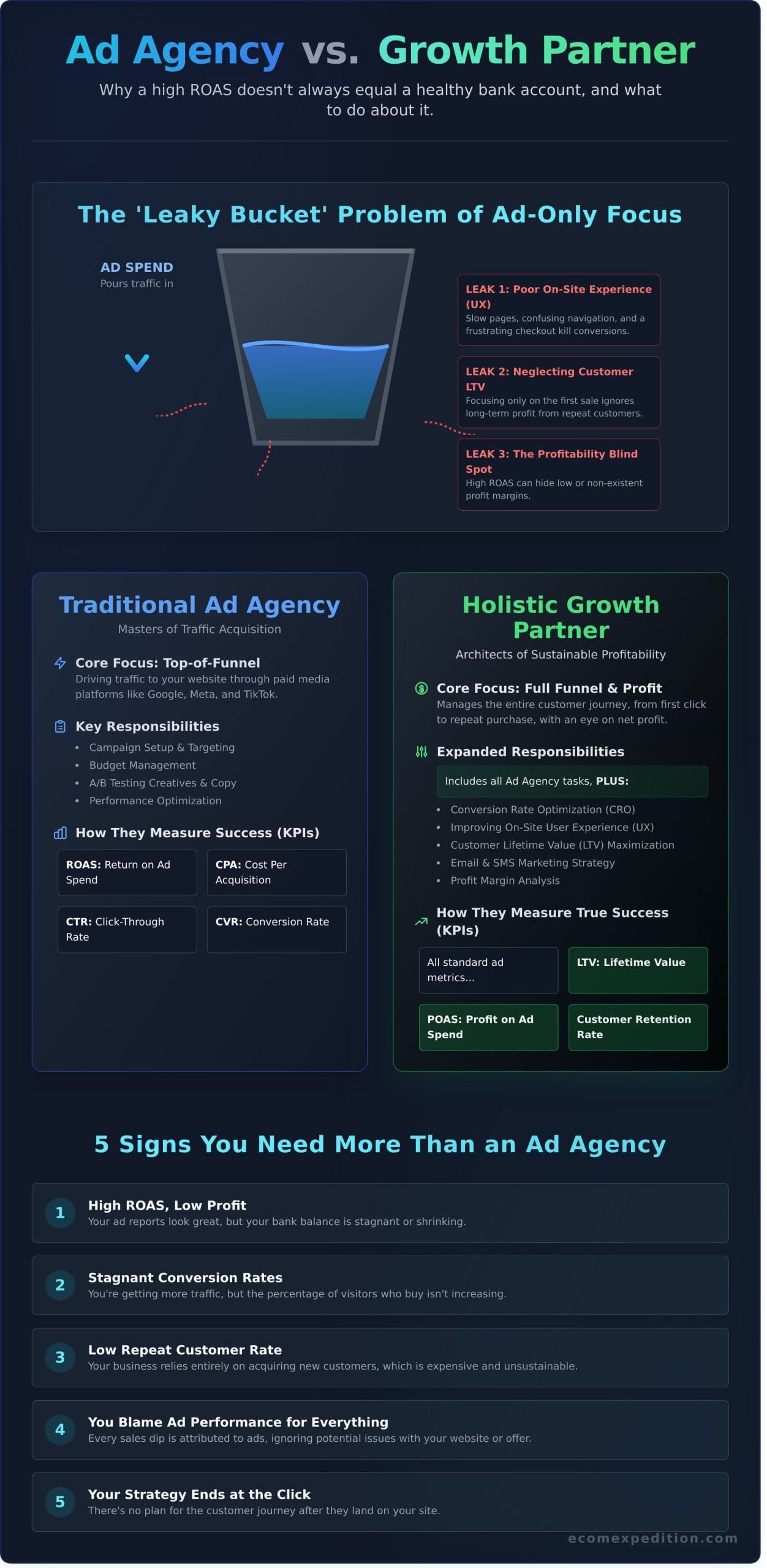
Imagine your e-commerce business is a bucket and your advertising efforts pour water-high-intent traffic-into it. The goal of a typical ad agency is simple: pour as much water as possible. But what happens if the bucket is riddled with holes? It doesn’t matter how much you spend on ads; the bucket will never fill. This is the fundamental flaw of an ad-only approach to growth.
Most agencies see their job as complete the moment a user clicks an ad. They drive traffic to your digital doorstep, but they are not responsible for what happens once a visitor crosses the threshold. They don’t fix the underlying business issues that kill conversions and suffocate profitability.
Problem 1: Ignoring the On-Site Customer Experience (UX)
An ad can be perfect, the targeting flawless, and the copy compelling-but it all means nothing if the destination is broken. Issues like slow page speeds, confusing website navigation, or a multi-step, frustrating checkout process are massive holes in your bucket. These UX failures destroy conversion rates, meaning the high-quality traffic you paid for simply gets frustrated and leaves. An agency can send you your ideal customer, but they can’t force them to stay on a site that doesn’t work.
This highlights the importance of a broader digital strategy. For example, agencies like the Slovak-based GoUP focus not just on traffic, but on improving on-site elements like widgets to ensure that traffic actually converts.
Problem 2: Neglecting Customer Lifetime Value (LTV)
Acquiring a customer is the most expensive part of the journey; true profitability is built on retention. A standard ecommerce ad agency is laser-focused on the first sale-driving down Customer Acquisition Cost (CAC) and maximizing immediate conversions. Their metrics rarely account for what happens next. Without a strategy for email marketing, loyalty programs, and post-purchase follow-up, you are stuck on an expensive hamster wheel, constantly paying to acquire new customers instead of nurturing the ones you already have.
This is where a more integrated agency can make a difference. For example, a digital marketing firm like WE Interactive builds CRM and customer marketing strategies to ensure that the customers you acquire are nurtured for long-term value.
Problem 3: The Profitability Blind Spot
A high Return on Ad Spend (ROAS) is the ultimate vanity metric if it isn’t tied to actual profit. An agency might proudly report a 4x ROAS, but this number exists in a vacuum. It doesn’t account for your product margins, shipping costs, operational overhead, or return rates. This is where a purely tactical approach fails. Without a comprehensive e-commerce strategy that aligns marketing with your P&L, you can easily scale your revenue while simultaneously shrinking your net profit. Real growth isn’t just about bigger numbers; it’s about better numbers.
The Strategic Alternative: A Holistic Ecommerce Growth Partner
Many brands hire an agency to “run their ads,” treating marketing as a simple transaction. This tactical approach often leads to wasted spend and stalled growth. A true growth partner operates differently. They look past campaign metrics to understand the entire business ecosystem. Their primary goal isn’t just to drive more traffic or revenue; it’s to increase sustainable profitability. This fundamental shift aligns every part of your business-from marketing and merchandising to operations-toward one unified objective: scalable, long-term success.
Beyond Ads: A Full-Spectrum Approach
A high-performing ad campaign can’t fix a leaky bucket. A strategic partner understands that paid media is just one component of a much larger system. Effective growth requires a deep understanding of the entire customer journey, as detailed in this comprehensive guide to e-commerce marketing, which goes far beyond simply launching ads. This holistic view connects every touchpoint to drive real business impact.
- Integrating paid media with Conversion Rate Optimization (CRO) to ensure the traffic you pay for actually converts.
- Aligning marketing with merchandising and Average Order Value (AOV) strategy to maximize the value of every customer.
- Developing robust customer retention strategies through email and SMS to maximize Lifetime Value (LTV).
- Ensuring branding and messaging are consistent across all channels to build trust and brand equity.
Strategy Over Tactics: Building a Foundation for Growth
The work of a genuine partner begins long before a single dollar is spent on ads. Instead of launching campaigns based on assumptions, we start with a deep dive into your business model, unit economics, margins, and long-term goals. This is what separates a growth partner from a typical ecommerce ad agency. We build a comprehensive growth plan first, acting as an extension of your internal team and sharing accountability for the results. This foundational work is what allows us to deliver superior outcomes. See how a strategic growth partnership drives 2-4x ROI.
5 Signs You Need More Than an Ad Agency
A great ecommerce ad agency is an expert at one thing: driving qualified traffic. But when growth stalls despite a steady stream of new visitors, the bottleneck is rarely the ads themselves. It’s a sign your business has graduated beyond tactical execution and now requires a comprehensive growth strategy.
If you recognize your business in the following scenarios, it’s time to seek a partner who can see the entire picture, not just the ad campaign dashboard.
- Your Traffic is High, but Sales are Flat.
This is the classic “leaky bucket” syndrome. An ad agency can fill the bucket, but if your website experience (UX), pricing, or core offer doesn’t convert, you’re just paying to acquire visitors, not customers. Pouring more ad spend into a broken conversion funnel is an expensive path to nowhere. The problem isn’t traffic; it’s what happens after the click. - Your ROAS is Good, But Your Bank Account Isn’t Growing.
Return on Ad Spend can be a dangerously misleading metric. A 4x ROAS feels great, but if your product margins can’t support your Customer Acquisition Cost (CPA), you’re effectively buying revenue at a loss. A true growth partner analyzes your entire financial model to ensure ad spend drives real, take-home profit, not just top-line numbers. - You Have No Clear Strategy for Repeat Business.
If 100% of your focus is on acquiring new customers, you’re on an exhausting and expensive treadmill. Sustainable scale is built on retention. You need a partner to develop the email flows, loyalty programs, and post-purchase experiences that maximize Lifetime Value (LTV) and create a resilient, profitable brand. - Your Brand Feels Inconsistent Across Channels.
Your ads promise one thing, but your landing page, welcome emails, and packaging tell a different story. This disconnect erodes trust and weakens your brand. A strategic partner ensures your message is cohesive across every touchpoint, building a unified brand experience that customers recognize and rely on. - You’re Constantly Reacting, Not Planning.
Are you always playing defense, responding to a competitor’s sale or a dip in performance? This reactive state is a symptom of a missing long-term strategy. Growth shouldn’t be a series of short-term fixes. It requires a proactive plan that builds a competitive moat around your brand, making it less vulnerable to market shifts.
Recognizing these signs isn’t a failure; it’s an indication of success. It means your business is ready for the next level of strategic thinking. When you’re ready to align every piece of your business for maximum impact, it’s time to explore a true growth partnership.
How to Choose the Right Partner for Profitable Scaling
Selecting the right partner is one of the most critical decisions you’ll make for scaling your brand. The market is filled with agencies that can execute ad campaigns, but very few operate as true growth partners. A tactical provider rents you their time; a strategic partner invests their expertise in your bottom line. To find the latter, you must ask better questions that cut through the noise and reveal their true approach. Arm yourself with these three questions in your next discovery call.
‘What is your process before you launch any ads?’
Listen carefully to their answer. A tactical agency will jump straight to audience research, keyword lists, and ad creative. This isn’t wrong, but it’s incomplete. A strategic partner will start with a comprehensive business audit. They will want to understand your unit economics, your contribution margin, and your P&L sheet. They know that profitable scaling isn’t about ad clicks; it’s about aligning ad spend with your fundamental business model.
‘How do you measure success beyond ROAS?’
Return on Ad Spend (ROAS) is a useful metric, but it only tells a fraction of the story. A high ROAS can easily mask low profitability. A superior ecommerce ad agency will anchor their success to metrics that directly impact your bank account. They will discuss your LTV to CAC (Lifetime Value to Customer Acquisition Cost) ratio, your net profit goals, and your MER (Marketing Efficiency Ratio). This focus proves they are committed to building a resilient, profitable business, not just generating vanity metrics.
‘How do you work with our team on non-ad-related issues?’
This question reveals whether you are hiring a siloed vendor or an integrated partner. Ads are only one piece of the puzzle. A true partner knows that driving traffic is useless if the conversion experience is broken. Look for an agency that actively collaborates with your team on landing page optimization, email and SMS marketing flows, and customer retention strategies. Sustainable growth requires a holistic, team-based approach where every part of the customer journey is optimized to drive profit.
The answers to these questions will clearly separate the tacticians from the strategists. At Ecom Expedition, this deep integration is the foundation of every growth partnership we build. We don’t just run ads; we drive outcomes.
From Ad Agency to Growth Partner: Your Next Step
The takeaway is clear: relying solely on an ad agency for growth is a short-term tactic, not a long-term strategy. While they excel at driving traffic, true profitability is achieved only when that traffic converts and returns. The right partner moves beyond the limited scope of a traditional ecommerce ad agency to build a foundation for sustainable scale by optimizing your entire growth engine.
At Ecom Expedition, we act as your strategic partner, not just a service provider. Backed by 27+ years of hands-on ecommerce experience, our focus is on delivering 2-4x ROI by aligning your ads, conversion rates, and retention efforts. If you’re ready to move beyond simply buying traffic and start building a truly profitable brand, we invite you to take the next step.
Book a free, no-obligation strategy call with us today. Let’s build the profitable, scalable business you’ve always envisioned.
Frequently Asked Questions
What is the difference between an ecommerce ad agency and a marketing agency?
The primary difference is focus. A marketing agency takes a broad approach, covering everything from SEO and PR to content. An ecommerce ad agency specializes in one critical area: driving direct, profitable revenue through paid media channels like Meta and Google. A true growth partner, however, blurs these lines by ensuring that a powerful ad strategy is fully integrated with your brand’s core marketing and financial objectives for sustainable, long-term growth.
How much does it cost to hire an ecommerce ad agency?
Costs vary based on the depth of the partnership. Most agencies use a model based on a percentage of ad spend, a flat monthly retainer, or a hybrid of both. The investment reflects the scope of work, from simple campaign management to comprehensive growth strategy. A premier ecommerce ad agency is not a cost center; it is an investment engineered to deliver a significant, measurable return on profitability and scale for your business.
What is a good ROAS for an ecommerce business?
A “good” ROAS is entirely dependent on your profit margins. A 4x ROAS might be highly profitable for a brand with 80% margins but a significant loss for one with 30% margins. We focus on a more critical metric: profit. True growth isn’t about vanity metrics; it’s about understanding your numbers to ensure every dollar of ad spend contributes directly to your bottom line. The goal is a profitable and scalable customer acquisition model.
Should I hire a freelancer or an agency for my ecommerce ads?
This depends on your growth objectives. A freelancer can be an excellent tactician for managing a single ad platform. An agency, however, operates as a strategic growth partner. You gain access to an integrated team of strategists, data analysts, copywriters, and media buyers who work in concert. This multidisciplinary approach ensures every decision is data-driven and aligned with your broader business goals, which is essential for achieving significant and sustainable scale.
How long does it take to see results from an ecommerce ad agency?
While initial data and traffic can materialize within the first 1-2 weeks, achieving consistent and profitable results requires a methodical approach. The first 30-60 days are a critical testing and optimization phase. Meaningful, scalable growth and a clear return on investment typically become evident within 90 days. Our process is built on a foundation of data-driven strategy, not short-term tactics, to build a predictable engine for long-term success.
What marketing channels are most important for ecommerce brands?
For direct, measurable growth, the foundational channels remain Meta (Facebook & Instagram) and Google Ads (Search, Shopping, PMax). These platforms capture both high-intent buyers and targeted audiences at scale. A truly holistic strategy then layers in email and SMS marketing to maximize customer lifetime value and retention. Depending on the brand, channels like TikTok and Pinterest can be powerful for top-of-funnel awareness and audience building, fueling the core conversion engines.