
A stunning e-commerce website that fails to drive profit isn’t an asset; it’s a liability. Too many brands learn this lesson after a significant investment, left with a beautiful digital storefront that leaks revenue and opportunity. The critical error often occurs before a single line of code is written: choosing the wrong partner. When evaluating an ecommerce website design company, it’s easy to be swayed by slick portfolios, but aesthetics are only a fraction of the formula for real growth. A true growth partner understands that design must serve a strategic business purpose.
This 2026 guide is built to change your approach. We are moving beyond subjective critiques to provide a clear, data-driven framework for selecting a partner who is accountable for your ROI. You will learn the precise criteria to distinguish a simple design vendor from a strategic team that aligns technology, user experience, and merchandising with your core profitability goals. Prepare to make your next investment with confidence, ensuring it becomes a powerful engine for scalable success.
Key Takeaways
- Shift your focus from aesthetics to performance by understanding what defines a profit-driven ecommerce website versus a simple digital brochure.
- Equip yourself with 10 critical questions to vet any ecommerce website design company, ensuring their process is built around strategic growth and measurable ROI.
- Learn to identify the five core pillars of a high-converting site, giving you a clear framework to evaluate a design partner’s capabilities beyond their portfolio.
- Understand the difference between a one-time project and a long-term growth partnership, and why the latter is essential for sustained profitability in a competitive market.
Beyond Aesthetics: What a Profit-Driven Ecommerce Website Actually Is
Many brands fall into a costly trap: they treat their website as a digital brochure. They invest heavily in a beautiful design, only to find that it fails to convert visitors into customers. This happens when aesthetics are prioritized over function. A truly effective ecommerce site is not a static gallery; it is a meticulously engineered sales machine designed for one primary purpose: to drive revenue and scale your business. To build one, we must first understand what is e-commerce at its core-a system for commercial transactions-and then design every component to facilitate that exchange.
The most successful online stores are built on a foundation of strategy over tactics. This means shifting the focus from fleeting design trends to the core user experience (UX) that guides a customer seamlessly from discovery to checkout. It’s the critical difference between a site that looks good and a site that sells.
The Cost of a Bad Website Design
A visually appealing but strategically flawed design is a direct threat to your profitability. The immediate damage is visible in your analytics: high bounce rates, abandoned carts, and dismal conversion rates. But the long-term consequences are more severe. A confusing or frustrating user experience erodes customer trust, damages brand perception, and hands market share directly to your competitors. Every day your site underperforms represents significant lost revenue and opportunity cost.
Moving from a ‘Look’ to a ‘Growth Engine’
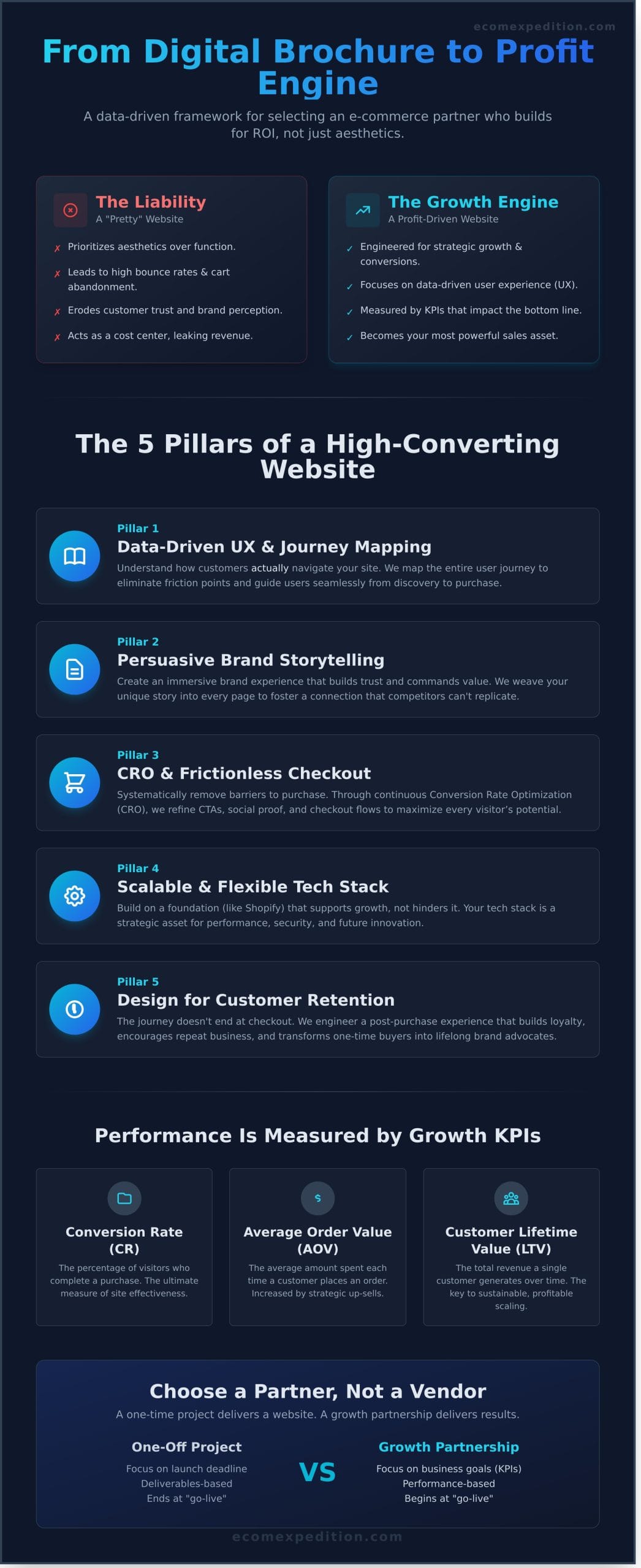
The essential mindset shift is moving from asking, “How does it look?” to “How does it perform?” A high-performance site, built by a strategic ecommerce website design company, ensures every element has a purpose tied to a specific business goal. The color of a ‘Buy Now’ button, the placement of a search bar, and the flow of the checkout process are all strategic decisions backed by data. Performance is measured by concrete Key Performance Indicators (KPIs) that directly impact your bottom line:
- Conversion Rate (CR): The percentage of visitors who complete a purchase.
- Average Order Value (AOV): The average amount spent each time a customer places an order.
- Customer Lifetime Value (LTV): The total revenue a single customer is predicted to generate over time.
When design decisions are aligned with these metrics, your website transforms from a cost center into your most powerful growth engine.
The 5 Pillars of a High-Converting Ecommerce Website
Effective ecommerce design is not about subjective aesthetics; it’s a strategic discipline built on a proven framework. While tactics change, the principles that drive profitability remain constant. We don’t guess. We build on five core pillars that align every design decision with the singular goal of scalable growth.
- Pillar 1: Data-Driven UX & User Journey Mapping. Understanding how customers actually navigate your site to find and purchase products.
- Pillar 2: Persuasive Brand Storytelling & Visual Merchandising. Creating an immersive brand experience that builds trust and commands value.
- Pillar 3: Conversion Rate Optimization (CRO) & Frictionless Checkout. Systematically removing barriers to purchase and maximizing every visitor’s potential.
- Pillar 4: Scalable & Flexible Technology Stack. Building on a foundation (like Shopify) that supports growth instead of hindering it.
- Pillar 5: Designing for Customer Retention, Not Just Acquisition. Engineering a post-purchase experience that creates loyal, repeat customers.
User Experience (UX) and Brand Storytelling
An intuitive user experience is the shortest path to a sale. When customers can find what they need effortlessly through logical navigation and clear site architecture, friction disappears and conversion rates increase. But a seamless journey is only half the equation. Professional branding weaves your unique story into every page, building the trust necessary to justify premium prices and foster a genuine connection that competitors cannot replicate.
Technology Stack and Conversion Optimization
Your technology platform is a strategic business asset. Choosing a robust and scalable solution like Shopify is not just a technical choice; it’s a commitment to performance, security, and future growth. This foundation enables critical performance factors like lightning-fast site speed, a flawless mobile-first design, and secure payment gateways. Upon this base, we implement targeted CRO elements-compelling calls-to-action (CTAs), social proof like customer reviews, and visible trust signals-to convert browsers into buyers methodically.
Finally, a truly strategic design prioritizes customer retention. Acquiring a new customer is far more expensive than retaining an existing one. A forward-thinking ecommerce website design company understands that the customer journey doesn’t end at checkout. This focus on the entire lifecycle, from first click to repeat purchase, is central to developing a strong e-commerce strategy that drives sustainable, long-term profitability. Your site architecture must support this with features like easy re-ordering and personalized account pages.
How to Evaluate an Ecommerce Design Company: 10 Questions to Ask
Selecting the right partner is the single most critical decision you’ll make for your online growth. The difference between a simple vendor and a true growth partner lies in the questions they can answer. A vendor builds what you ask for; a partner challenges your assumptions to deliver what your business actually needs. Use this vetting checklist during your sales calls to move beyond surface-level discussions and identify a genuine ecommerce website design company that is invested in your profitability.
When researching potential partners, it’s helpful to look at examples of agencies that embody these principles. For instance, an award-winning creative web design company like Insight Multimedia demonstrates how a strong portfolio can be backed by a clear focus on strategic growth for their clients. Examining the work of established firms can give you a solid benchmark for what to look for in your own search.
Questions About Strategy & Process
These questions cut through the design portfolio to reveal an agency’s strategic depth. A partner’s process should be rooted in understanding your business goals, target audience, and key performance indicators. Their answers will show if they prioritize your ROI or just their creative vision.
- 1. How do you measure the success of a website design project? Look for answers tied to business metrics like conversion rate, average order value (AOV), and customer lifetime value (LTV)-not just aesthetic approval.
- 2. What is your discovery process for understanding our business and customers? A strong partner will detail a comprehensive process involving stakeholder interviews, data analysis, and customer journey mapping.
- 3. Can you show me a case study where you improved a specific business metric? This demands tangible proof. Ask them to walk you through how their design choices directly led to measurable growth for a previous client.
- 4. How do you approach customer retention and LTV in your designs? This tests their long-term thinking. Do they build features for post-purchase engagement, loyalty programs, and repeat business?
- 5. How do you ensure the site we build today is scalable for future growth? A forward-thinking agency will discuss modular design, platform flexibility, and a technical architecture built for expansion.
Questions About Technology & Partnership
A successful project depends on seamless execution, transparent communication, and a plan for what happens after launch. These questions assess the operational and relational aspects of working with an ecommerce website design company, ensuring they have the technical prowess and collaborative spirit to become an extension of your team.
- 6. Which e-commerce platforms do you specialize in and why? Their rationale is key. It should align with your specific business needs for scalability, integrations, and total cost of ownership.
- 7. How do you handle project management and communication? Expect clear answers about dedicated project managers, communication tools (like Slack or Asana), and a regular cadence for updates.
- 8. What does post-launch support and optimization look like? A true growth partnership doesn’t end at launch. Inquire about their process for ongoing conversion rate optimization (CRO), A/B testing, and technical support.
- 9. How do you integrate with our other marketing and operational tools? Their ability to connect your site with your ERP, CRM, and email marketing stack is non-negotiable for a streamlined operation.
- 10. Who from your team will I be working with directly? Ask to understand the experience level of the strategists, designers, and developers who will be hands-on with your project.
The Strategic Design Process: From Kickoff to Growth
A world-class e-commerce site isn’t built on guesswork or a trendy template. It’s the calculated result of a methodical, data-driven process. Many brands fear the complexity of a redesign, but a professional partner demystifies the project lifecycle to eliminate the unknown. This disciplined approach moves from initial discovery to sustained, profitable growth, standing in stark contrast to rushed projects that prioritize speed over results.
Phase 1: Deep Dive & Strategic Roadmap
This is the foundational phase where most projects fail before they even begin. Before a single pixel is designed, a true ecommerce website design company must immerse itself in your business. This isn’t a brief questionnaire; it’s a comprehensive discovery process where we become an extension of your team. Key activities include:
- In-depth competitor analysis to identify market gaps and opportunities.
- Ideal customer journey mapping to understand user motivations and remove friction.
- Technical audits and KPI alignment to set clear, measurable goals for success.
The output isn’t a design mock-up. It’s a strategic blueprint-a detailed roadmap that dictates every subsequent decision to ensure your new site is engineered for profitability.
Phase 2: UX, Design & Development
With the strategic blueprint as our guide, we meticulously translate insights into function and form. This phase begins with user experience (UX) wireframes that map out conversion-focused layouts, followed by high-fidelity visual designs that bring your brand to life with purpose. Our development is an iterative process, involving rigorous user testing and quality assurance at every stage. We focus on building a clean, scalable codebase, ensuring your website is not only powerful at launch but also flexible enough to evolve and scale with your business demands.
Phase 3: Launch, Optimization & Partnership
A successful launch is the starting line, not the finish. This is where a project ends and a partnership begins. Once your site is live, our focus shifts from building to optimizing. We meticulously monitor analytics, track user behavior against the KPIs established in Phase 1, and implement A/B testing to validate our strategic assumptions and uncover new growth opportunities. This data-driven feedback loop transforms your website from a static asset into a dynamic engine for continuous improvement and the foundation of a true growth partnership.
Why a Growth Partnership Delivers More Than a One-Off Project
Implementing the best practices outlined in this guide is the first step toward building a high-performance ecommerce store. But a website is not a static asset; it’s a dynamic growth engine that requires constant optimization, strategic iteration, and a deep understanding of your business goals. This is where the traditional agency model falls short and a true partnership becomes essential for long-term profitability.
The Limitations of a Traditional Agency Model
Most agencies operate on a project basis. Their primary goal is to build and launch your website. While the initial result may be beautiful, this model has inherent flaws that limit your growth potential:
- Focus on a Finish Line: The project is considered “done” on launch day. The agency is incentivized to complete the build, not to drive your key performance indicators (KPIs) in the months and years that follow.
- Misaligned Incentives: Once the final invoice is paid, their work is over. Your long-term success-conversion rates, customer lifetime value, and profitability-is not tied to their compensation.
- The Solo Journey: After launch, you are handed the keys to a complex system and left to manage it alone. The team that built your growth engine is no longer there to help you run it.
The Ecom Expedition Partnership Advantage
We built our entire model to solve these problems. At Ecom Expedition, we don’t just build websites; we build businesses. Our Growth Partnership is designed to align our success directly with yours, creating a powerful synergy for sustained growth. Backed by 27+ years of experience, we know that launch day is just Day One.
As a different kind of ecommerce website design company, we operate as a deeply integrated extension of your team. We share accountability for your revenue goals and use the strategic framework from this guide as our ongoing roadmap. Our process is built to deliver a 2-4x return on your investment by continuously aligning design, technology, and marketing to drive real-world results. Your success becomes our obsession.
Your website should be your most powerful asset for scaling your brand. If you’re ready to move beyond a simple project and build a true growth engine, we should talk. Book a Free Strategy Call to build your growth engine.
Your Partner in Profitability: The Right Choice for Growth
The difference between stagnation and scale often comes down to your choice of an ecommerce website design company. The right partner moves beyond aesthetics, focusing on a strategic process that drives measurable results. They understand that a successful website is not a one-off project, but a long-term growth engine built on a deep understanding of your business goals and customer behavior.
At Ecom Expedition, we embody this philosophy. We are a true growth partner, not just a project vendor. Backed by 27+ years of e-commerce experience, our entire methodology is engineered to deliver a 2-4x ROI for our partners. We integrate with your team to build a comprehensive strategy for sustainable profitability.
If you are ready to invest in a partnership that delivers real impact, let’s talk. Book a Free Strategy Call to Discuss Your Growth Goals and discover what a profit-driven approach can do for your brand. Your next stage of growth is waiting.
Frequently Asked Questions
How much does it cost to hire an ecommerce website design company?
The cost to hire an ecommerce website design company is an investment in a primary growth asset. For established brands seeking a strategic, custom-built site, budgets typically start around $25,000 and can exceed $100,000 for highly complex projects with extensive integrations. This investment covers comprehensive strategy, UX/UI design, development, and conversion rate optimization. The final price depends on the project’s scope, complexity, and the depth of the growth partnership you require for long-term success.
What makes a good ecommerce website in 2026?
By 2026, a top-tier ecommerce site will be defined by hyper-personalization and seamless integration. It will move beyond simple responsiveness to offer AI-driven product recommendations, predictive search, and a completely unified experience across all channels (web, mobile, in-store). Key features will include augmented reality try-ons, one-click checkout processes, and a headless commerce architecture that allows for unparalleled speed and flexibility. The focus is on creating a frictionless, context-aware customer journey that drives retention.
How long does it take to build a custom ecommerce website?
A professionally managed, custom ecommerce website project typically takes between 12 and 20 weeks from the initial discovery call to launch. This timeline is broken into strategic phases: discovery and strategy (2-4 weeks), UX/UI design (3-6 weeks), development and integration (5-8 weeks), and finally, quality assurance testing and launch (2-3 weeks). This methodical process ensures every element is aligned with your core business objectives and built for scalable growth from day one.
Should I use a template or get a custom ecommerce design?
While templates offer a fast and low-cost entry point, a custom design is an investment in long-term profitability and brand equity. A template limits your ability to create a unique user experience and optimize conversion pathways specific to your audience. A custom design, built on a strategic foundation, allows for a differentiated brand presence, superior performance, and the scalability required to meet your future growth targets. For serious brands, custom design delivers a significantly higher ROI.
What’s the difference between an ecommerce design company and a developer?
The difference is strategy versus execution. A freelance developer is a technician who writes code to build features. An ecommerce website design company is a strategic growth partner. We provide a holistic team that includes strategists, UX/UI designers, developers, and project managers. Our role isn’t just to build a website; it’s to architect a comprehensive digital ecosystem designed to drive revenue, increase profitability, and align with your most critical business goals.
Do I need to hire a company that specializes in Shopify?
While platform expertise is important, it’s secondary to strategic ecommerce expertise. However, for businesses committed to a specific platform like Shopify, partnering with a certified expert offers distinct advantages in maximizing the platform’s potential. To see an example of a firm with deep Shopify knowledge, you can check out NB eCommerce & Design. Ultimately, the best partner is one who first diagnoses your business needs and then recommends the right technology to achieve your growth objectives, combining broad strategy with specific platform mastery.
What information should I prepare before contacting an agency?
To ensure a productive first conversation, you should prepare a clear overview of your business objectives. This includes your revenue goals, target audience personas, and key performance indicators (KPIs) you want to improve. Also, compile a list of essential features (e.g., subscription models, loyalty programs) and provide examples of 2-3 websites whose design and functionality you admire. This preparation allows us to move directly into a strategic discussion about driving results for your business.
How do I measure the ROI of a new website design?
The ROI of a new design is measured through a clear set of performance metrics that are directly tied to profitability. We don’t guess. We track key indicators like conversion rate, average order value (AOV), customer lifetime value (CLV), and cart abandonment rate. A successful redesign will show measurable improvement in these areas. For example, a 1% increase in conversion rate can translate to a significant lift in revenue, demonstrating the direct financial impact of your investment.